Bollywood celebrity weddings: How Anushka changed the trend
On December 11, 2017, Anushka Sharma and Virat Kohli converted a 40-to-42-person wedding in Tuscany into the highest-yield celebrity wedding template in India.
Bollywood Celebrity Weddings: How Anushka Sharma Changed the Trend
The event did not need a stadium-sized guest list, a television exclusive, or a running paparazzi feed. It had the opposite operating model: roughly a year of secrecy, a controlled destination, two globally recognisable principals, and a tightly timed Instagram release. The result was an unusually efficient cultural rollout. Within hours, the Virushka wedding was not merely private news made public. It had become the reference point for Bollywood celebrity weddings.
Its commercial influence was visible across four assets: pastel bridalwear, destination privacy, restricted guest lists, and professionally packaged visual content. That combination changed the perceived value of a celebrity wedding. Scale stopped being measured only by ballroom capacity. It began to be measured by image circulation.
The Tuscany blueprint: secrecy became an asset
The Virushka wedding details still matter because the event was built around scarcity.
Anushka Sharma and Virat Kohli married at a resort in Tuscany, Italy, with only around 40 to 42 guests in attendance. At the time, the benchmark for famous Bollywood couples’ marriage celebrations leaned in a different direction: large guest counts, multiple public-facing functions, extensive media movement, and receptions designed to accommodate industry networks.
The Tuscany plan reduced the number of people who could leak details. It also reduced visual clutter. A limited guest list gives the production team control over almost every frame: entrances, interiors, floral design, family photographs, and the couple’s first official images.
The secrecy operation reportedly ran for about a year. Bookings were made under fake names to prevent premature disclosure. The exact aliases are not public, and they do not need to be. The relevant metric is the result: there was no prolonged leak cycle that could dilute the announcement.
That is the core financial logic behind the event’s impact. A leak produces attention, but it often produces low-value attention. Grainy airport images and partial venue reports create noise without giving the couple control over the final narrative. Virushka retained the premium reveal.
Secrecy was not a decorative detail. It was the distribution strategy.
For celebrity wedding trends in India, this was a major reset. Privacy was no longer interpreted as an absence of spectacle. It became part of the spectacle itself.
A destination wedding, particularly one outside India, also created a practical buffer. The venue was geographically removed from Mumbai’s paparazzi ecosystem and from the usual density of film-industry guests. Tuscany was not selected simply for postcard value. It functioned as a perimeter.
The model can be reduced to a straightforward equation:
- Fewer guests meant fewer leak points.
- Fewer leak points protected the announcement window.
- A protected announcement window increased the value of official imagery.
- Official imagery then carried the full public narrative.
The output was disproportionately large relative to the guest count. That is strong cultural ROI.
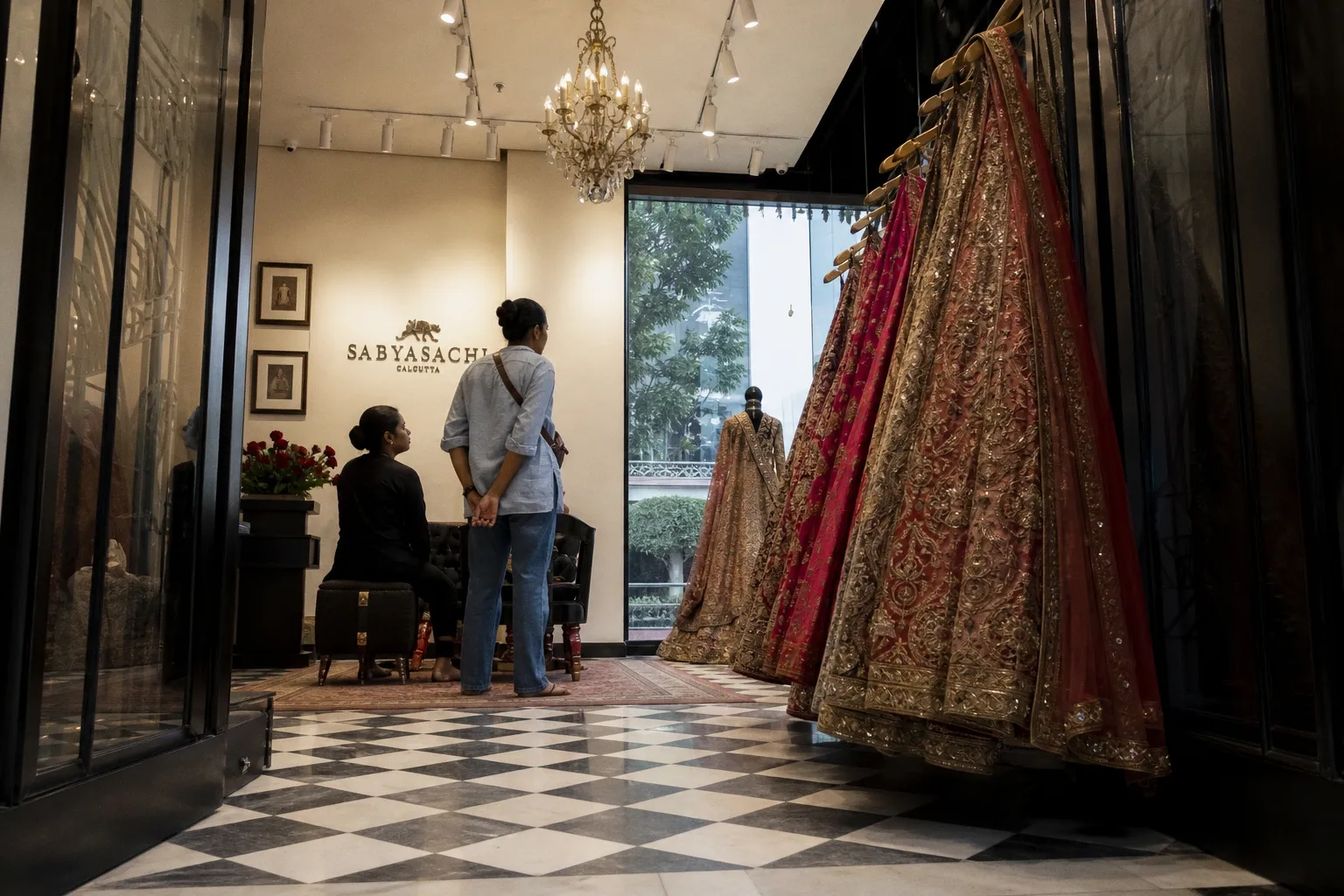
From red to pastel: the Sabyasachi lehenga changed the bridal market
The most visible yield from the wedding was Anushka Sharma’s bridal lehenga.
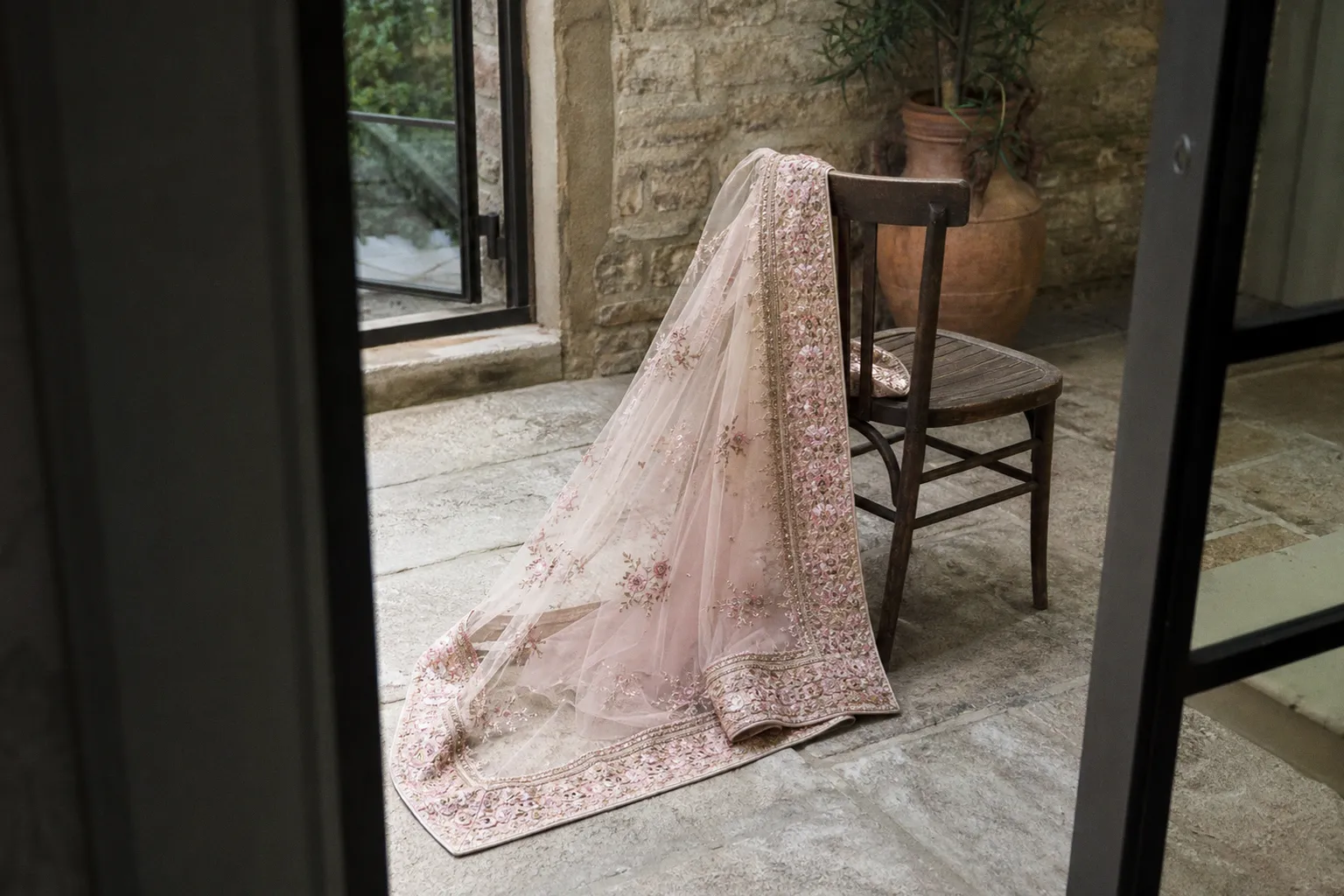
Designed by Sabyasachi Mukherjee, the blush pink outfit required 67 karigars and 32 days of work. Those figures matter because they turn a fashion moment into an industrial one. The lehenga was not a casual styling choice that happened to photograph well. It was a high-labour couture product placed at the centre of one of India’s most watched celebrity announcements.
Traditional red and maroon bridalwear did not disappear after December 2017. Nor was Anushka the first Indian bride to wear a pastel shade. That claim would be inaccurate. What changed was the mainstream market signal. Pastel stopped being a marginal alternative and became an aspirational default for brides seeking a “celebrity wedding” visual language.
Blush pink was especially effective because it performed on multiple channels at once. It read softly in daylight, retained detail in professional photographs, complemented the Tuscany setting, and stood apart from the saturated reds associated with conventional wedding imagery.
The shift can be read as a change in risk calculation for brides and designers.
| Bridal decision | Pre-Virushka mainstream signal | Post-Virushka market signal |
|---|---|---|
| Primary colour | Red, maroon, deep jewel tones | Blush, powder pink, peach, ivory, muted florals |
| Visual mood | Formal, ornate, high-contrast | Soft-focus, coordinated, editorial |
| Venue relationship | Outfit designed independently of location | Outfit, décor and daylight treated as one frame |
| Couture appeal | Embroidery density as the main visible marker | Craft plus photographic texture and colour balance |
| Social media value | Function documentation | Shareable hero image |
The key term is coordination. The lehenga did not operate as a standalone fashion asset. It was part of a total visual portfolio: pale florals, soft outdoor light, Virat Kohli’s ivory-toned sherwani, restrained décor, and photography calibrated for digital circulation.
That is why the effect extended beyond one shade of pink. Designers and wedding planners absorbed the broader lesson: an outfit now had to work as a screen image, not just as a garment seen at close range.
A saturated red lehenga still has strong ceremonial equity. But pastel weddingwear acquired a new yield: it could signal both luxury and intimacy without looking under-produced. That distinction drove demand.
The intimate guest list became a prestige marker
A 40-to-42-person guest list is not automatically inexpensive. It is simply a different allocation model.
In large Indian weddings, expenditure is often spread across scale: catering volumes, multiple venue capacities, security, transportation, guest management, entertainment, and a long invitation roster. The Virushka format redirected prestige away from volume and toward curation.
That had a direct effect on how Bollywood destination weddings were discussed afterward. A smaller guest list could now imply selectivity rather than limitation. The phrase “intimate wedding” gained brand value.
For public figures, the economics are clear. A tightly managed celebration allows greater control over the parts audiences eventually see:
1. Guest composition becomes part of the story.
With 40 guests rather than several hundred, every attendee has a defined relationship to the couple. There is less room for generic industry networking and more room for family-led images.
2. The location carries more of the luxury signal.
Tuscany supplied architecture, landscape and natural light. That reduces the need for oversized décor to manufacture scale in a conventional ballroom.
3. Security becomes more efficient.
A reduced guest footprint and an overseas venue make access management more practical. The goal is not invisibility forever; it is control until the official release.
4. Photographs gain scarcity value.
When there are no uncontrolled images circulating beforehand, the first professional frames become the event itself in public memory.
5. The wedding can retain emotional cues without becoming tabloid material.
This is a crucial distinction. The format looked personal, but the output remained highly polished. It was intimacy with production discipline.
The broader shift did not eliminate big celebrity receptions. It created a two-stage model that many high-profile couples could use: a closed wedding for core guests, followed by a larger public or industry-facing celebration. The private ceremony delivers exclusivity. The later reception handles network obligations.
For celebrities, that split improves operational control. For audiences, it creates a more legible narrative: first the protected wedding album, then the public appearances.
Curating the aesthetic: a wedding became a media product
The Virushka wedding was designed by Devika Narain, photographed by Joseph Radhik, and filmed by Vishal Punjabi of The Wedding Filmer. This is not a credit-roll detail. It explains why the event had such a long afterlife.
Celebrity weddings had been photographed professionally before 2017. The difference was the integration of every visual department into a same-day publishing system. Design, wardrobe, photography, film and social posting operated like a coordinated release campaign.
The couple released polished wedding photographs on Instagram on the day of the ceremony, accompanied by a short joint caption. That move now appears standard. At the time, it changed the sequence of celebrity wedding news.
The older model was usually reactive. Media outlets reported what they could obtain: venue images, attendee arrivals, partial confirmations, leaked invitations, or post-event reception photographs. The Virushka model was proactive. The couple became the primary newswire.
That created three advantages.
First, it protected image quality. The first frames that reached millions were carefully shot, colour-corrected and selected. There was no low-resolution preview lowering the perceived production value.
Second, it centralised authorship. The public did not receive scattered interpretations of the ceremony before seeing the couple’s own version. The official post set the tone, the visual hierarchy and the emotional temperature.
Third, it compressed the media cycle. A single post could trigger coverage across entertainment desks, fashion platforms, wedding publishers and fan accounts without handing editorial control to any one outlet.
The official Instagram post did not document the wedding after the fact. It was the opening weekend.
This is the point at which celebrity wedding photography moved closer to campaign photography. The images had to work in a magazine-style layout, on a phone screen, across reposts, and in the compressed visual environment of social media feeds.
The production package also created a repeatable vendor benchmark. A celebrity couple looking to build an equally controlled wedding reveal needed more than a glamorous venue. They needed an integrated visual team with a clear release protocol.
That is the lasting operational lesson from the event. A wedding can be private in attendance and public in impact, but only if the public-facing material is planned before the first guest arrives.
Why the Virushka effect lasted beyond one wedding season
Many celebrity wedding trends fade because they are tied too closely to one personality, one location or one fashion house. The Virushka effect lasted because it solved several industry problems at once.
It gave stars a way to reduce press intrusion without surrendering public relevance. It gave designers a new visual category with immediate consumer pull. It gave planners a premium format built around curation rather than excess. And it gave social media a polished announcement style that could generate massive reach without a long promotional runway.
The format also suited the changing economics of fame. Celebrity attention is fragmented. Film stars, cricketers, influencers and streaming personalities all compete for the same digital bandwidth. A wedding announcement must now deliver a complete visual proposition quickly. The Tuscany model did that.
Its components were highly transferable:
- a restricted attendee list;
- a scenic but controlled destination;
- coordinated neutral or pastel styling;
- a designer-led décor system;
- professional stills and film;
- a joint, same-day social announcement.
Not every couple can reproduce the Tuscany location or the Sabyasachi production scale. That is not the point. The real export was the framework. It allowed weddings at different budgets to borrow the appearance of exclusivity through tighter guest management, softer palettes and deliberate photography.
There is also a limit to the model. Once every wedding uses pastel décor, daylight portraits and an “intimate” caption, the differentiation yield declines. Saturation is unavoidable. The market then looks for a new marker of rarity: a different destination, a more distinctive craft story, a less expected silhouette, or greater privacy.
But the original template remains unusually durable because it was not built on excess. It was built on control.
The financial verdict on a cultural reset
Anushka Sharma and Virat Kohli did not publish the total cost of their Tuscany wedding, and there is no verified figure for the overall event budget. Any precise number would be speculation.
The measurable output is more useful anyway: a 40-to-42-person ceremony, a year-long secrecy strategy, a blush pink lehenga made by 67 artisans over 32 days, and an official social-media release that reset the public rollout for Bollywood celebrity weddings.
That package delivered exceptional cultural ROI. It shifted the bridal colour conversation, increased the prestige of intimate destination ceremonies, and established the controlled Instagram reveal as a standard operating model.
The projected lifetime gross of the Virushka wedding is not counted in ticket sales. It is counted in every pastel lehenga, restricted guest list and same-day celebrity wedding post that still uses its 2017 blueprint.