Spot fake Sabyasachi lehengas: One bride's online scam
A fake Sabyasachi lehenga scam rarely begins with a clumsy-looking website anymore.
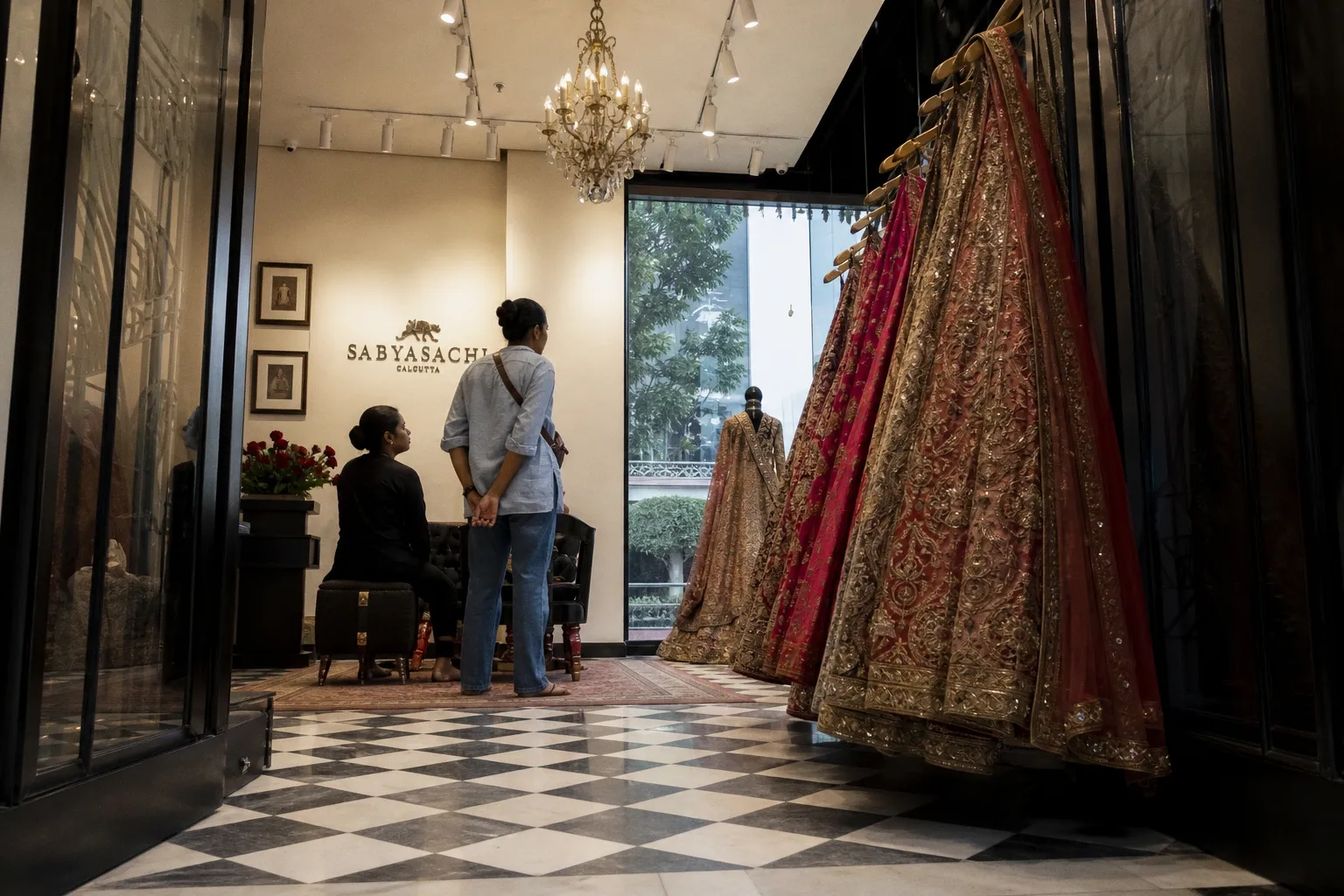
That is the trap. The scammer is not selling a lehenga first. They are selling the emotional crescendo of the wedding moodboard — the same visual language brides have absorbed from Bollywood weddings, Vogue shoots, Instagram reels, and airport-to-altar celebrity coverage. So if you are trying to figure out how to check one bride's online scam before paying an advance, do not start with the embroidery. Start with the sales channel, the price, and the way the seller behaves when you ask inconvenient questions.
I’m usually the person obsessing over mixing, vocal texture, synth loops and whether a playback hook lands cleanly in the final chorus. But luxury bridal fraud has its own sound design. There is a rhythm to it: stolen image, impossible price, urgent DM, advance payment, silence — then a low-quality parcel that looks like the original only if you squint through heartbreak.
The anatomy of the bridal bait-and-switch
The classic fake Sabyasachi setup is almost musical in structure. It opens with a familiar motif: a real image. Not a similar image. Often an actual photograph lifted from a celebrity wedding, a runway presentation, an editorial shoot, or a bride who wore the real thing.
That is why the page feels believable at first glance. The lighting is right. The embroidery looks expensive. The styling has that deep, maximal Sabyasachi timbre: heritage red, layered jewellery, regal textiles, nothing flat or flimsy. The scammer does not need to create luxury; they sample it.
Then comes the switch.
You message the page. The seller says the piece is “Sabyasachi-inspired,” “same to same,” “first copy,” “export surplus,” or “direct karigar piece.” Sometimes they avoid those words and claim it is “original stock” available through a “private channel.” The price is the hook: ₹35,000, ₹60,000, maybe ₹95,000 for something that, in authentic bridal couture terms, lives in a completely different price universe.
Authentic Sabyasachi bridal lehengas typically sit around ₹3 lakh to ₹15 lakh-plus, depending on textile, handwork, customization and collection. That is not a random flex number. It reflects the labour, atelier structure, design ownership, brand positioning and finishing quality behind the garment.
A fake seller compresses all of that into a fantasy price and hopes the bride’s heart moves faster than her verification process.
The scam works because the photo is real, the feeling is real, and only the seller is fake.
The most painful version is the bait-and-switch delivery. The Instagram grid shows a bridal lehenga with dense embroidery and cinematic weight. The parcel contains mass-produced fabric with dull threadwork, plastic-looking embellishment, poor lining, a blouse that does not sit correctly, and a dupatta that has none of the original’s drape. The silhouette collapses. The colour is off. The whole garment has the audio equivalent of a badly compressed MP3: all the signal stripped out, only noise left.
Why the price tag is the first bassline to listen for
Luxury bridal wear has many emotional layers, but price is still the cleanest diagnostic note. If a seller claims to offer a genuine Sabyasachi bridal lehenga at a heavy discount, your suspicion should spike instantly.
Official Sabyasachi products are not floating around online at “mega sale” prices. The brand does not run the sort of discount chorus that fast-fashion pages love: “70% off,” “clearance,” “limited stock,” “today only.” That language belongs to scam pages and unauthorized replica sellers, not to verified couture sales.
Here is the practical breakdown:
| Claim from seller | What it usually means | What a bride should hear |
|---|---|---|
| “Original Sabyasachi under ₹1 lakh” | False pricing signal | A genuine bridal lehenga at that level is not credible |
| “Factory outlet piece” | Common counterfeit script | Sabyasachi is not selling bridal couture through random outlet pages |
| “Same design, same karigar” | Unauthorized replica pitch | Craft resemblance is not authenticity |
| “DM for secret discount” | Pressure-led sales tactic | Official luxury does not need hidden WhatsApp bargaining |
| “Celebrity wedding piece available” | Stolen-image bait | Ask why a couture piece from a public wedding is suddenly in stock |
This is where brides need to be almost nerdy about the mix. A luxury purchase has a full arrangement: brand channel, invoice, appointment, fitting, packaging, communication trail, after-sales clarity. Scam sellers isolate one shiny instrument — the photo — and bury every other part under urgency.
I have seen this same pattern in fan culture too. A leaked “exclusive” track appears online, the cover art looks right, the title looks plausible, but the vocal texture is wrong and the mastering is mush. The ear catches what the eye wants to ignore. With bridal couture, the ear becomes your process: listen for the sales language. Real luxury sounds controlled. Scam luxury sounds desperate.
Why you cannot buy Sabyasachi bridal couture through Instagram DMs
This part needs to be said without decoration: Sabyasachi Mukherjee’s bridal lehengas are not sold through third-party e-commerce websites or casual social media DMs. Official sales happen through the brand’s own flagship stores or its verified website.
That means an Instagram page with “Sabyasachi” in the handle is not automatically legitimate. A polished Shopify-style storefront is not automatically legitimate. A WhatsApp catalogue with 400 images is not automatically legitimate. Even a page with thousands of followers and comments full of heart emojis is not proof of authenticity.
Social media is brilliant at building desire. It is terrible as a stand-alone proof of legitimacy.
The scammer’s advantage is speed. They know a bride may be juggling venue payments, family opinions, makeup trials, jewellery appointments, and a hundred tiny wedding decisions that all arrive like percussion hits in the same bar. So the seller offers relief: “Madam, don’t worry, we will make exact piece.” “Booking amount only today.” “Dispatch in 20 days.” “Video call possible after advance.”
But authentic couture is not a food-delivery checkout. Bridal wear at this level involves controlled consultation, sizing, design confirmation, and official retail handling. If someone is trying to close a supposed Sabyasachi bridal purchase entirely inside Instagram DMs, that is not convenience. That is the trapdoor.
A few questions expose the weak mix fast:
1. Which official Sabyasachi flagship store or authorized retail point is handling the sale?
A real seller can point you toward verifiable official channels. A fake seller will pivot to “private sourcing” or “direct workshop.”
2. Can the seller prove they are listed by the brand as authorized?
Not by a screenshot they made. Not by a forwarded PDF. By matching the official retail network.
3. Will payment go to a verified brand entity or recognized retail partner?
Random personal accounts, newly created business names, and pressure to transfer quickly are ugly distortion.
4. Is the pricing aligned with authentic bridal couture?
If the number is dramatically below the ₹3 lakh to ₹15 lakh-plus band, do not romanticize it as a miracle.
5. Is the seller using celebrity or runway images without showing the actual garment?
That is the scammer’s favourite sample loop.
For broader consumer-awareness reading around online buying habits and everyday digital caution, I’d also keep an eye on practical culture-and-life resources like Bycepni, because the same fraud mechanics keep resurfacing across categories: urgency, imitation, social proof, and too-good-to-be-true pricing.
The official retail network is not a decorative detail
In celebrity culture, names travel faster than facts. A bride sees “Sabyasachi” in a caption and the brain fills in the rest: Deepika’s regal wedding energy, Anushka’s elegance, Katrina’s bridal glow, the whole Bollywood wedding archive that has trained us to read certain textiles as status.
But a brand name in a caption is only typography. Verification lives elsewhere.
Sabyasachi maintains official channels and an authorized retail network. If a store or online portal is not listed through official brand sources, treat it as unauthorized. That does not mean every unauthorized seller is using the same scam script, but it does mean they are not a legitimate route to buying authentic Sabyasachi bridal couture.
The hard truth: “Sabyasachi-style” is not Sabyasachi. “Inspired by” is not Sabyasachi. “Replica” is not a harmless bargain; it is an unauthorized copy and often part of a messy, illegal, exploitative supply chain. Brides sometimes use softer language because the desire is genuine. They do not want to feel fooled. They want to feel resourceful.
I get it. Weddings are financially brutal. The pressure to look like the moodboard while staying inside a family budget is real. But the counterfeit market feeds on that pressure. It does not democratize couture; it monetizes anxiety.
A replica seller is not giving you access to luxury. They are using luxury’s image to sell you risk.
And the risk is not only aesthetic. There may be no reliable refund. No accountable fitting process. No guarantee on fabric quality. No honest disclosure about materials. No protection if the item never arrives. No clean answer when the blouse is wrong, the colour bleeds, or the embroidery starts shedding before the sangeet.
Red flags that make the whole arrangement fall apart
A scam page usually has one or two impressive elements and five or six rotten ones. The trick is not to be hypnotized by the loudest instrument in the mix.
Here are the signs I would not ignore:
- The page uses only polished bridal campaign images, with no real client fittings or verifiable store presence.
Stolen imagery is the lead vocal of this scam. If every photo looks like it came from a magazine spread, ask where the actual inventory is.
- The seller refuses to name an official store or authorized retail partner.
“We are direct manufacturer” is not an answer. For genuine Sabyasachi, the route matters.
- The discount is theatrical.
A supposed ₹8 lakh lehenga offered for ₹75,000 is not a lucky find. It is a siren.
- The language keeps pushing urgency.
“Last piece,” “booking closing tonight,” “price will increase after 2 hours” — these are pressure drums, designed to stop you from checking.
- Payment is requested into a personal bank account or wallet.
Especially if the name does not match any verifiable business entity connected to an authorized retailer.
- They claim the piece is “first copy” but still imply luxury authenticity.
This is contradiction dressed as negotiation. If it is a copy, it is not authentic.
- They dodge video verification of the actual garment.
Even videos can be stolen, yes. But refusal to show current, detailed, live proof is still a bad sign.
- The page has suspicious engagement.
Repeated comments, generic praise, no tagged brides, no credible customer trail, and sudden follower spikes all create a hollow chorus.
- The seller becomes defensive when asked for verification.
Real luxury retail is used to serious questions. Scam sellers treat questions like insults because scrutiny ruins the performance.
I would add one emotional red flag too: if you feel embarrassed to ask questions because the seller is acting exclusive, pause. That is part of the theatre. A bride spending serious money has every right to verify.
The Bollywood effect: why Sabyasachi scams feel so persuasive
Sabyasachi is not just a designer label in India’s wedding imagination. It is a pop-cultural instrument. It has scored celebrity weddings, magazine covers, red carpet memory, and the aspirational grammar of bridal Instagram. The brand’s visual identity is strong enough that even a partial imitation can trigger recognition.
That is why these scams spread so easily in India entertainment and Bollywood circles. A celebrity wedding look becomes a viral image. Fan pages repost it. Bridal pages reinterpret it. Replica accounts harvest it. Within days, the same lehenga appears across dozens of grids, each claiming access, discount, or customization.
The scammer is surfing the aftershock of fame.
This is where my audio brain kicks in. A great playback song can inspire a hundred remixes, but the original has depth: the singer’s breath placement, the composer’s arrangement, the lyricist’s internal rhyme, the way percussion enters at the right millisecond. A fake may copy the hook, but it cannot reproduce the architecture.
A genuine couture piece is similar. The weight of the fabric, the density of handwork, the finishing inside the garment, the fall of the skirt, the way the dupatta border sits — these are not flat visual elements. They are construction. They are craft. They are the difference between hearing a live orchestra and a ringtone version of one.
What to do before paying any advance
If a bride has already found a page and is tempted, the next steps should be calm and boring. Boring is good. Boring saves money.
First, verify the channel. Go to the official Sabyasachi website and check the brand’s own retail information. Do not rely on what the seller sends you. If the seller claims association with a store, cross-check that store against the brand’s authorized network.
Second, treat heavy discount language as a near-fatal flaw. Authentic Sabyasachi bridal lehengas do not become “clearance deals” on random portals. If the price is drastically below the expected couture range, the seller needs impossible proof — and in most cases, they will not have it.
Third, reverse-search images when possible. Many scam pages reuse the same celebrity wedding, runway or editorial photos. If the image appears elsewhere as a known campaign or bride photo, the seller must prove they possess the actual garment. Usually, they cannot.
Fourth, ask for documentation before emotion enters the room. Official invoices, store details, appointment confirmations, and traceable payment channels matter. A screenshot with a logo is not documentation. A WhatsApp promise is not documentation.
Fifth, do not pay an advance because a seller says another bride is waiting. There is always “another bride” in scam scripts. She is the invisible backing vocalist pressuring you into the chorus.
If money has already been paid and the seller has gone silent, collect everything: chat records, payment receipts, account details, page links, screenshots, courier information, and product images. Then report through appropriate cybercrime and consumer complaint channels. I won’t pretend recovery is guaranteed. It often is not. But documentation gives you a fighting chance and helps platforms identify repeat fraud patterns.
The final listen: desire is not the enemy, shortcuts are
Wanting a Sabyasachi bridal moment is not foolish. The label has earned its place in the Indian wedding imagination because the design language is powerful: old-world richness, cinematic colour, craft-heavy detail, a kind of visual orchestration that photographs beautifully and carries emotional weight.
The problem begins when a scammer offers the crescendo without the composition.
So the cleanest answer to how to check one bride's online scam is this: verify the seller before you admire the lehenga. The image can lie. The caption can lie. The discount definitely can lie. But official channels, authorized retail status, realistic pricing, and accountable payment trails are harder to fake when you actually press on them.
My recommendation, after close-listening to this whole ugly genre of bridal fraud: if the purchase path does not sound like luxury retail, do not dance to it. Genuine Sabyasachi has replay value because the craft holds up beyond the first photo. A counterfeit only needs to survive until your advance clears.