New Hindi web series list: Why indie creators now dominate OTT
The Quiet Power Shift Behind the New Hindi Web Series List…

The most interesting thing about the new Hindi web series list right now is not the slate itself but who is being trusted to make it. Across Netflix India, Prime Video, JioHotstar and the long tail of regional streamers, the commissioning logic of 2026 has tilted noticeably toward digital-native creators and away from the star-vehicle model that defined the post-pandemic streaming boom. What looks like a sudden disruption is actually a market correction, and reading the correction honestly is the only way to read the upcoming slate at all.
For most of the last five years, the Indian OTT story was told in volume: 383 streaming originals launched in 2023, the industry's all-time peak, before the category contracted by 18% in 2024 and another 13% in 2025, ending the year at 274 properties. That is not a marginal dip; it is a 28% pullback from the high-water mark in just two years. With that contraction has come a rethink. Platforms are no longer buying scale. They are buying specificity, and creators who arrive with audiences already attached are the cleanest shortcut to specificity the business has found.
The Shrinking Volume of Original Content: A Market Correction
There is a temptation, when scanning any new Hindi web series list, to read it as a record of expansion: more shows, more platforms, more choice. The actual record of 2025 tells a quieter story. According to Ormax Media's streaming-original supply analysis, Indian platforms launched 274 original properties in 2025, down from roughly 315 the year before, and well below the 383-title peak of 2023. The market is not collapsing; it is recalibrating after a post-pandemic spending spree that produced more series than the audience could sustainably absorb.
Fiction, rather than reality formats or direct-to-OTT films, continues to do the heavy lifting: scripted series accounted for 71% of the originals launched in 2025. That ratio matters for anyone tracking the Hindi web series space specifically, because it tells us where the artistic effort is going. Reality and short-form vertical content, the latter exemplified by JioHotstar's TADKA micro-format, which the platform says crossed 100 million users by mid-June 2026 across more than 100 original titles, are growing as parallel categories, but they are not displacing the long-form scripted series as the prestige centre of gravity. They are expanding the edges of what counts as an OTT original.
The contraction has had one useful side effect: it has forced platforms to be more deliberate about which stories they commission, and which storytellers they trust with them.
Beyond the Star System: How Platforms are Partnering with Digital Creators
The most visible manifestation of that deliberation is the platform-creator partnership model. It is not the case that digital creators have seized control of the Indian OTT industry. The public evidence does not support that claim at the level of overall commissions, viewing time or revenue. What the evidence does support is that the major streamers have made a strategic choice to weave digital-native talent into their slates as a structural element, and the difference matters.
Netflix's 2026 India lineup is the clearest illustration. Among its announced titles sit Dhindora Season 2, associated with Bhuvan Bam, alongside more conventionally produced projects such as Operation Safed Sagar, Chumbak, Yeh Dil Sun Raha Hai, Musafir Cafe and Maa Behen. The slate is a hybrid: established production partners including Red Chillies Entertainment, T-Series, Yash Raj Films, Maddock, Dharma Productions and Balaji Telefilms remain the connective tissue, but they are now joined by creators who built their audiences on YouTube, Instagram and short-form platforms long before the streamers ever came calling.
The shift is not the takeover of OTT by digital creators; it is the integration of digital creators into a commissioning structure that still belongs, decisively, to the platforms.
The model has even produced its own release-format experiments. India's Got Latent, the comedy showcase built around creator Samay Raina, was confirmed for a Season 2 launch on June 20, 2026 at 7 pm IST, simulcast on Netflix and YouTube, with episodes released every two weeks. That kind of cross-platform release window is unusual for a Netflix India original, and it points to how seriously the platform is taking the creator's existing audience infrastructure. The decision is not made for the benefit of Netflix subscribers alone; it is engineered to carry a digital-native audience across platforms without friction.
Prime Video India has signalled the same intent from a different angle. Its 2026 slate was announced at close to 55 Hindi, Tamil and Telugu titles, with The Viral Fever named among its 2026 production partners. Prime also disclosed that close to two-thirds of its Indian customers now consume content in more than four languages, which reframes what "Hindi web series" even means at a platform level: the language of the commission is increasingly plural, even when the protagonist's first language is Hindi.
The Rise of Connected TV and the Shift in Viewing Habits
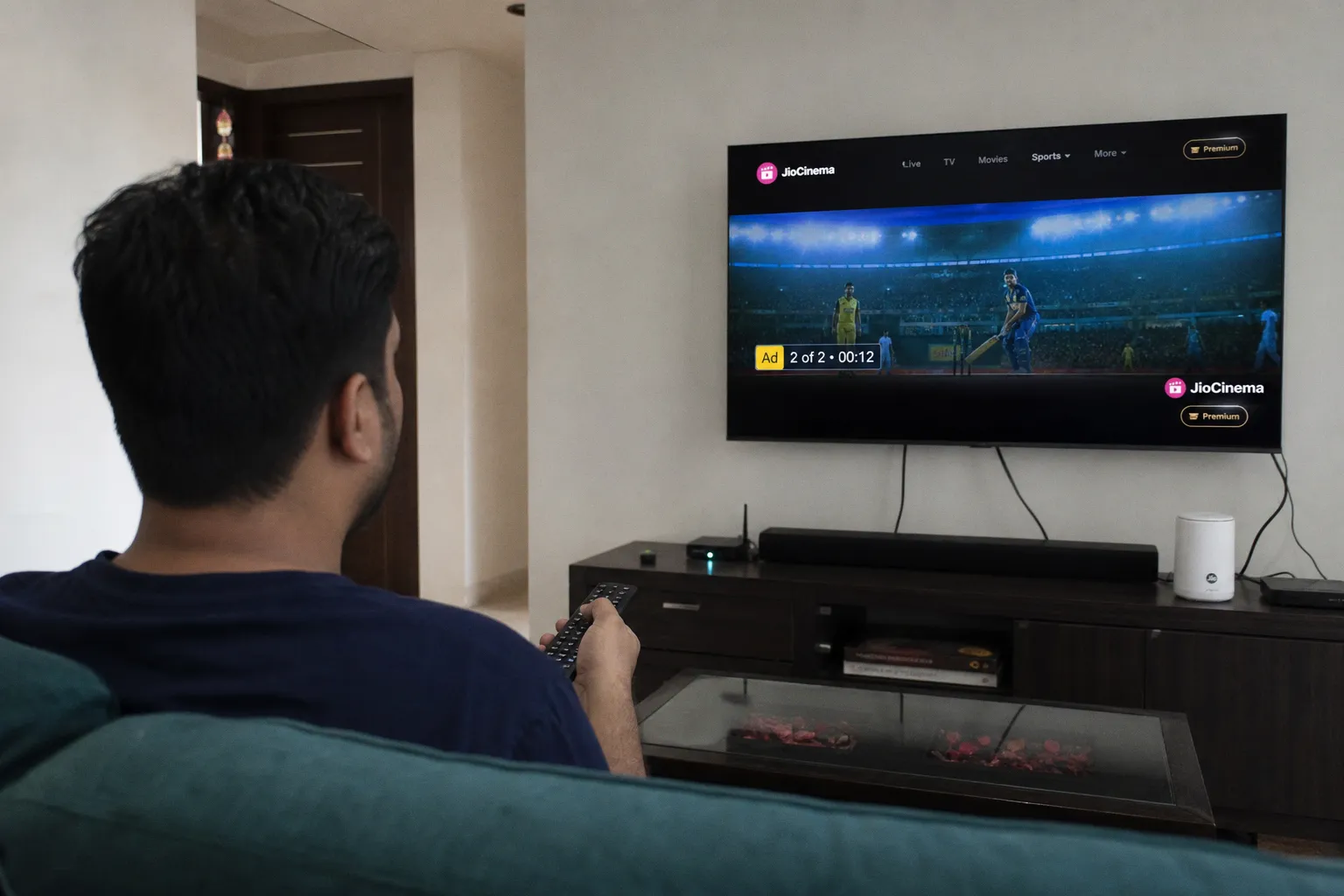
Behind every change in what gets made is a change in how it gets watched, and the most consequential shift in Indian viewing habits between 2024 and 2025 was the explosion of connected-TV adoption. Active CTV viewers in India rose from 69.7 million in 2024 to 129.2 million in 2025, an 85% year-on-year jump that effectively doubled the addressable CTV audience in a single year. The total online-video audience, meanwhile, was estimated at 601.2 million people, equal to about 41% of the country's population, counting anyone who watched online video at least once in the previous month.
What that means for the Hindi web series list is simple but easy to understate: Hindi OTT is no longer a phone-only product. A creator like Bhuvan Bam built his audience on a six-inch screen held vertically; the work of translating that audience to a fifty-five-inch screen in the living room is now the work of the streamer. The pacing, the visual grammar, the episode lengths, all of these are being quietly re-engineered to survive the jump from a metro commuter train to a family sofa in a tier-two city. That is not just a technical adjustment; it is a tonal one. A series that sings on a phone can feel claustrophobic on a TV; a series that breathes on a TV can feel slack on a phone. The new slate is being calibrated for both.
There is also a financial undercurrent here worth naming. India's video-subscription revenue reached an estimated ₹9,200 crore in 2024, up 11% year on year, and the government's December 2025 briefing pegged paying OTT users at somewhere between 9.5 and 11.8 crore. For viewers weighing which subscription is worth keeping through 2026, the arithmetic increasingly resembles any recurring consumption decision, and the way capital gets allocated to growth categories in this part of the economy can be cross-referenced against how the architecture of stock markets, ETFs and investment funds treats rising recurring-revenue categories.
Hindi vs. Regional: Navigating the Changing Language Landscape
For most of the last decade, "Hindi web series" was effectively synonymous with "Indian OTT originals." That equivalence is softening. Hindi accounted for 60% of Indian streaming originals launched in 2025, down from 65% in 2024. It is still the largest single-language category by a comfortable margin; no regional language is close to challenging it in absolute terms. But the trajectory is clear.
The most telling comparator is Telugu. Telugu original launches rose from 28 in 2024 to 35 in 2025, a 25% jump that runs directly against the overall market's contraction. Tamil, Marathi, Malayalam and Bengali have all added incremental weight to the slate. What is happening is not the death of Hindi streaming; it is the diversification of the Indian streaming economy around Hindi as its gravitational centre. A new Hindi web series list in 2026 is no longer a complete map of Indian streaming; it is one language's account of a multilingual conversation.
This also explains why the creator economy numbers, read alongside the OTT originals data, are so striking. India had roughly 0.96 million content creators in 2020 and 4.12 million by 2025, a quadrupling in five years. Sixty-six per cent of that creator base sits outside the major metros, and while 42% of creators work in Hindi, the regional languages collectively account for 58%. The platforms are not chasing creators because creators are a Hindi phenomenon; they are chasing creators because creators are a regional phenomenon that has begun to feed Hindi-language commissioning in unexpected and welcome ways.
The 2026 Slate: What to Expect from Netflix, Prime Video and JioHotstar
With the macro context set, the actual new Hindi web series list for 2026 begins to come into focus. It is, by design, narrower than the 2023 peak but more deliberate. The character arcs feel more closely supervised; the thematic resonance is being engineered rather than stumbled into.
On Netflix, the announced Hindi and Hindi-led slate for 2026 includes Dhindora Season 2, Operation Safed Sagar, Chumbak, Yeh Dil Sun Raha Hai, Musafir Cafe and Maa Behen, alongside India's Got Latent Season 2. The slate mixes creator-led projects with mid-budget studio productions and a flagship comedy event. Several of these titles were announced without confirmed public release dates at the time of writing and should be read as upcoming rather than released.
Prime Video India's 2026 calendar of close to 55 titles spans Hindi, Tamil and Telugu, with The Viral Fever now formally inside the production ecosystem. The platform's own data, that nearly two-thirds of its Indian customers watch in four or more languages, suggests that even its Hindi titles will increasingly be co-commissioned with regional-language originals rather than developed in isolation.
JioHotstar's 2026 strategy is harder to map onto a conventional "Hindi web series" frame, because TADKA, its 30-to-60-second vertical format, is functionally a different product category. But the platform's announcement that TADKA crossed 100 million users by June 11, 2026 is a useful reminder that the same screen real estate is now shared between long-form scripted Hindi series, micro-form vertical content, live sport and reality television, and that the boundaries between them are increasingly porous.
| Platform | 2026 Hindi-led slate (announced) | Distinctive feature |
|---|---|---|
| Netflix India | Dhindora S2, Operation Safed Sagar, Chumbak, Yeh Dil Sun Raha Hai, Musafir Cafe, Maa Behen, India's Got Latent S2 | Cross-platform simulcast model with digital creators |
| Prime Video India | ~55 titles across Hindi, Tamil, Telugu; The Viral Fever now a production partner | Multilingual co-commissioning strategy |
| JioHotstar | Conventional Hindi series alongside TADKA vertical micro-format (100+ titles, 100M users) | Hybrid long-form plus short-form stack |
Closing Assessment
Read end to end, the new Hindi web series list of 2026 is not the list of an industry being taken over from below. It is the list of an industry learning to work with a creator class it once ignored. The contraction in original volume has forced selectivity, the CTV boom has changed the screen, and the regional tilt has changed what "Hindi" can plausibly mean at a national scale. Digital creators have not displaced the streamers or the legacy studios. They have been given a more prominent seat at a table that still belongs, fundamentally, to the platforms paying for the meal. The most interesting Hindi web series of the next twelve months will be the ones that know how to use that seat well: the ones whose pacing survives the leap from phone to television, whose character arcs respect the regional turn, and whose thematic resonance earns the trust the streamers have finally extended.