Bollywood dance songs that saved a cross-cultural wedding
The useful number is 120–130 BPM. That is the operating range where many Bollywood dance songs stop being “cultural programming” and start functioning as dance-floor infrastructure. Below it, footfalls soften. Above it, mixed-age guests leak out of the floor.
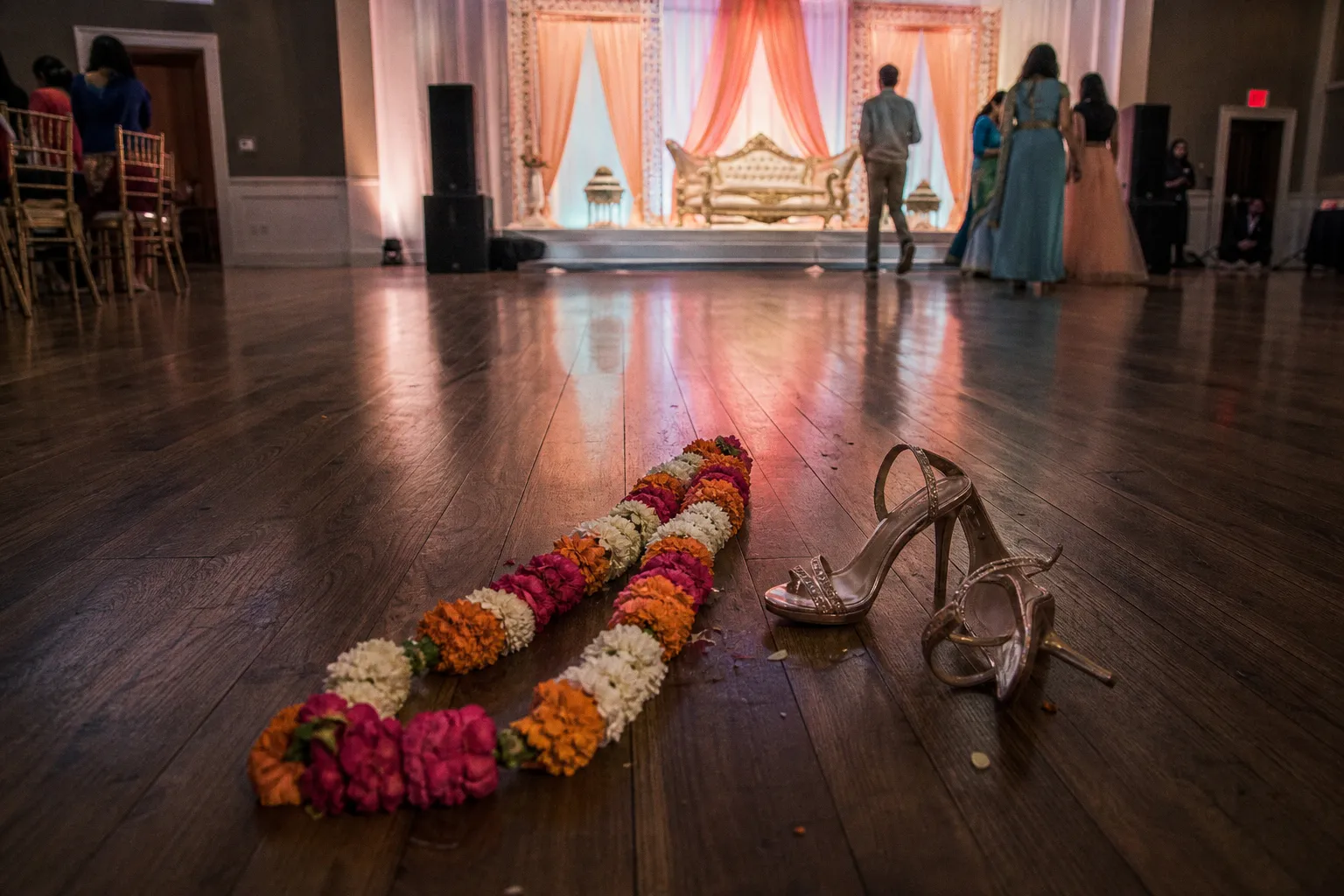
For cross-cultural weddings, the music problem is rarely a lack of songs. It is an allocation problem. One side wants emotional recognition. The other needs accessibility. Grandparents need something they can clap to. College friends need a hook. The couple needs a three-to-five-minute performance that does not collapse under choreography risk. Bollywood has become a high-ROI asset in that mix because it carries rhythm, spectacle, and easy group participation in one package.
The sangeet turned into a global format
The sangeet was not built as a destination-wedding content machine. Traditionally, it was a pre-wedding musical gathering: family songs, teasing lyrics, percussion, participation. Low production cost. High social return.
That structure has now moved into cross-cultural weddings globally. The ceremony is no longer limited to Indian families staging a familiar ritual. It has become a bridge product. Indian and non-Indian relatives meet on the same floor, usually through a choreographed medley. Bollywood supplies the common operating language.
The economics are clean. A sangeet-style event gives a wedding one extra night of programmed entertainment without needing the formal pressure of the reception. It spreads emotional investment across families. It also creates visible participation. In wedding terms, that is high yield.
The global version usually has three changes:
1. The playlist becomes bilingual in function, even when the lyrics are not. A Hindi hook can carry the floor if the beat is direct and the chorus has a repeatable movement.
2. The choreography becomes modular. Families learn 20- to 30-second blocks. No one needs full-stage competence.
3. The medley becomes the default format. Three to five minutes is the sweet spot. Long enough for both cultures to appear. Short enough to avoid rehearsal drag.
That last point matters. A wedding performance is not a concert. It is a risk-managed display of family buy-in. The best hindi dance tracks for this setting are not always the most musically complex. They are the ones that create instant participation with low instruction time.
In a cross-cultural wedding, the winning song is not the one with the loudest fan base. It is the one with the lowest barrier to entry.
This is why tracks such as “London Thumakda” from Queen and “Gallan Goodiyaan” from Dil Dhadakne Do have become durable assets. Both sit inside a celebratory register. Both work for group movement. Both give choreographers enough rhythmic structure to mix Bhangra, freestyle, and Western pop staging without fighting the track.
The playlist is a portfolio, not a dumping ground
A bollywood wedding playlist fails when it is treated like a memory drawer. Every cousin adds a favourite. Every uncle demands one 1990s track. The result is emotional inflation and poor floor retention.
The better build is portfolio logic. Each song has a job. Opening track. Family bridge. Couple spotlight. Nostalgia unit. High-tempo closer. If two songs perform the same function, one is dead weight.
A practical fusion wedding set usually needs five kinds of assets:
| Playlist function | What it must deliver | Bollywood fit | Risk if misallocated |
|---|---|---|---|
| Opening signal | Immediate recognition, claps, low intimidation | Big celebratory chorus, dhol-heavy intro | Guests stay seated too long |
| Family participation | Easy gestures, group lines, no technical footwork | “London Thumakda”-type energy | Older guests opt out |
| Cross-cultural bridge | Beat accessible to non-Hindi speakers | Pop structure, clear drops, repeatable hook | One side watches instead of joining |
| Nostalgia allocation | Emotional value for parents and older cousins | 90s or early-2000s Hindi hit | Floor slows if tempo dips too far |
| Closing lift | 120–130 BPM push, high recall | Modern chart-topper or wedding anthem | Performance peaks too early |
The 50%+ nostalgia mix often seen in fusion wedding playlists is not accidental. Older Bollywood tracks carry memory equity. Modern chart-toppers carry energy. A playlist that ignores nostalgia loses family buy-in. A playlist that overweights nostalgia loses kinetic efficiency.
That is the central trade-off.
The better DJs and choreographers do not argue over taste. They look at flow. A 1990s segment can work if it is clipped, remixed, or placed between two high-yield tracks. A modern hit can fail if it has a long intro, uneven tempo, or lyrics that do not match the wedding context.
Not every popular bollywood dance number belongs at a wedding. Some songs have the right beat and the wrong lyrical frame. Some are built for club circulation, not family optics. That difference matters more in cross-cultural settings, where many guests are already decoding unfamiliar cues.
Why “London Thumakda” and “Gallan Goodiyaan” keep clearing the market
Certain songs become wedding defaults because they solve multiple problems at once. “London Thumakda,” released in 2014, became one of those assets. Its advantage is not only recognition. It is design.
The track opens with a festive pulse. It allows clapping almost immediately. The hook is strong. The gestures can be broad rather than technical. For a mixed group with uneven dance skill, that matters. It lets a choreographer build a visible performance without needing professional-grade execution.
“Gallan Goodiyaan,” released in 2015, has a different yield profile. It is a group-performance engine. The song carries a family-celebration frame and gives space for rotation: bride’s side, groom’s side, friends, parents, then full group. It is not just a track; it is a staging template.
Their endurance comes from four measurable advantages:
1. Tempo compatibility. They work near the high-energy wedding band. The floor does not sag.
2. Group elasticity. They can hold six dancers or sixty.
3. Cultural clarity. The sound is recognisably Bollywood without requiring guests to understand every lyric.
4. Choreography efficiency. Basic moves look full when performed by a crowd.
This is the core reason bollywood dance songs have moved beyond Indian-only wedding programming. They scale. A track that works only for trained dancers has limited private-event ROI. A track that makes average guests look coordinated has repeat value.
There is also a visual economy at play. Wedding videos reward synchronized movement. Bollywood choruses reward it too. The match is obvious. A sangeet performance built around strong chorus sections gives the videographer clean peaks: entrance, hook, lift, final pose. That is not artistic theory. It is production efficiency.
Bolly-fusion reduced the execution risk
The rise of professional Bolly-fusion choreography changed the market. Couples do not need families to understand Kathak grammar, Bhangra form, or Hindi film references in full. They hire someone who can convert those references into accessible movement.
Bolly-fusion typically mixes Indian forms with Hip-Hop, Jazz, or commercial pop staging. In practical terms, it gives choreographers more tools. A parent group can use hand gestures and simple Bhangra bounce. Friends can take a Hip-Hop break. The couple can move into a softer Western ballroom phrase if needed. The same medley can carry several identities without turning into a cultural lecture.
The strongest fusion routines tend to obey a simple structure:
- Start with the most accessible beat. Do not open with the most technically Indian movement if half the room is unfamiliar with it. The opening needs footfalls, not education.
- Introduce cultural texture in layers. Dhol, hand gestures, shoulder movements, and group circles can build recognition without overload.
- Keep solo sections short. Long solos increase rehearsal burden and reduce group payoff.
- Use Western pop transitions carefully. A Top 40 insert can help non-Indian guests re-enter the floor, but too many switches dilute the Bollywood centre of the performance.
- End with a full-cast hook. The last 20 seconds should be the easiest and biggest movement phrase. That is where the video yield sits.
This is where professional choreographers earn their fee. The value is not just better steps. It is risk control. They know which sections can be learned over video calls, which relatives need front-row placement, and which transitions will break under pressure.
A private wedding performance has weak tolerance for complexity. There are travel schedules, jet lag, uneven rehearsal attendance, and family politics. A good Bolly-fusion build accepts that. It uses repeatable patterns. It creates the impression of scale without demanding technical precision from every dancer.
The medley is not a playlist shortened for convenience. It is a risk model with music attached.
The 120–130 BPM band is the commercial sweet spot
Tempo is not everything. It is just the first filter that prevents obvious losses.
For wedding dance floors, 120–130 BPM gives the DJ and choreographer a strong base. It is fast enough for energy, but not so fast that older guests abandon the floor. It also sits close enough to many Western pop and dance tracks to allow smoother mixing. That matters in cross-cultural weddings where the same set may move from Bollywood to Top 40, Latin pop, Afrobeats, Punjabi pop, and back again.
Once the BPM range is right, the second screen is structure. Songs with long cinematic intros can work in films but drag in private events. Tracks with clear percussion entries work better. Songs with repeatable hooks outperform tracks that are lyrically dense but rhythmically inconsistent.
There is a difference between a hit and a wedding asset. A hit has streams. A wedding asset has repeat deployment.
For DJs, that means reading the room in real time. For choreographers, it means selecting tracks that can survive imperfect execution. For couples, it means resisting the urge to include every song that has personal meaning. Personal meaning has value. But if the track cannot carry mixed guests, it belongs in the dinner playlist, not the dance set.
The best sangeet dance songs share certain commercial traits:
| Trait | Why it matters on a mixed floor | Strong use case |
|---|---|---|
| Clear beat entry | Guests know when to move | Group entrances |
| Repetitive chorus | Non-Hindi speakers can follow gesture cues | Family performances |
| Moderate-high tempo | Keeps energy without exhausting the room | Reception dance block |
| Festive lyrical context | Avoids awkward mismatch with ceremony tone | Bride/groom side medleys |
| Remix flexibility | Allows Western pop or regional inserts | Fusion playlists |
This is also why YouTube and Spotify user-generated “Fusion Wedding” playlists have expanded. The demand is not only for music discovery. It is for sequencing. Couples and planners are outsourcing the first layer of curation to public playlists, then refining for family needs.
Still, streaming popularity is not a final verdict. Algorithms reward repeat listening. Weddings reward instant usability. Those are different markets.
The cross-cultural floor needs sequencing discipline
A multi-ethnic wedding guest list is not one audience. It is a stack of micro-audiences with different recognition levels. Indian parents may respond to a 90s Hindi hook. American college friends may need a Western beat reference. British-Asian cousins may move fastest to Punjabi-inflected Bollywood. Older guests may respond to claps and circles before choreographed drops.
The playlist must rotate value across those groups. If one segment dominates for too long, participation narrows.
A practical 25- to 35-minute post-performance dance block might run like this:
1. Bollywood opener with a known chorus. The floor needs an anchor. A familiar Hindi film track signals that the sangeet or reception dance block is open.
2. Bhangra or Punjabi-pop lift. Strong dhol patterns convert watchers into clappers. Clappers become dancers.
3. Western pop bridge. One recognisable English-language track resets guests who are less familiar with Hindi music.
4. Modern Bollywood chart-topper. Bring the centre back to the Indian side without losing the broader floor.
5. 90s nostalgia clip. Short, high-recognition, placed after the floor is already warm.
6. Full-energy Bollywood closer. Use the biggest hook when the room has maximum density.
That order is not sacred. The logic is. Alternate recognition pools. Protect tempo. Do not leave any guest segment idle for too long.
The same applies to a three-to-five-minute family medley. If the bride’s side performs two Hindi tracks and the groom’s non-Indian side enters only at the end, the balance may look symbolic rather than integrated. Better to intercut. Ten seconds of one side, ten seconds of the other, then a shared chorus. The visual message is clearer. The performance risk is lower.
For the couple’s own dance, Bollywood can play either role: centrepiece or lift. Some couples start with a Western slow song and then break into a Hindi dance number. Others open with Bollywood and move into pop. Both structures work if the transition is clean. The weak version is the abrupt cut that feels like two separate performances stitched for obligation.
The stronger version uses a bridge: a percussion rise, a lyric cue, a choreographed freeze, or a DJ edit that matches tempo. That is where private-event production has become more sophisticated. The best weddings now treat the dance edit like a mini soundtrack.
Rights, DJs, and the quiet business behind the floor
Private weddings rarely discuss music in the language of territory rights, licensing exposure, or performance economics. They should at least understand the outline.
Bollywood music is not a casual commodity. It sits inside a label ecosystem, film rights structures, public performance rules, DJ edits, and platform availability. For most private clients, the immediate concern is simple: hire legitimate vendors, use professional DJs, and avoid relying on poor-quality rips from video platforms. Bad audio compresses the beat. Compressed beat reduces floor yield.
There is also a market signal in how songs circulate. A track that stays active across weddings for years creates long-tail value beyond its original film release. “London Thumakda” and “Gallan Goodiyaan” are examples of soundtrack assets with extended private-event utility. Their film box office cycle ended long ago. Their wedding deployment continues.
That is a different revenue and relevance curve from a typical film song that spikes during release marketing and then fades. Wedding adoption extends shelf life. It keeps a track in DJ libraries, choreography studios, short-form video edits, and family performance culture.
For labels and music producers, the wedding market is not always measured cleanly in public numbers. Exact revenue from private wedding licensing is not transparent. But the behavioural evidence is visible: playlists, choreography reels, sangeet packages, and repeated deployment by DJs across geographies.
The wedding floor has become a secondary distribution channel. Not official in the way theatrical territory rights are official. But commercially meaningful.
How to build the medley without killing the room
The three-to-five-minute medley is the most efficient format for cross-cultural wedding performance. It has enough time for representation and not enough time for boredom. The margin is thin.
A strong medley usually carries four to six song excerpts. More than that and the edit becomes a trailer. Fewer than that and one cultural side may feel under-served. Each excerpt needs a clear job.
A workable structure:
| Segment | Duration | Function | Music type |
|---|---|---|---|
| Opening | 20–30 seconds | Establish celebration and invite attention | Recognisable Bollywood hook |
| Family block | 40–60 seconds | Give parents/siblings easy choreography | Sangeet-friendly Hindi track |
| Fusion switch | 30–45 seconds | Bring in non-Indian guests or Western style | Pop-compatible Bollywood or Top 40 bridge |
| Couple spotlight | 30–45 seconds | Centre the bride and groom | Romantic-to-dance transition |
| Group finale | 60–90 seconds | Maximise bodies on floor and video payoff | High-tempo Bollywood anthem |
The failure points are predictable. Too much lyrical intro. Too many formations. Overlong couple solos. A final track that is less energetic than the second track. Choreography designed for dancers rather than relatives.
The medley should be built backwards from the finale. If the final 60 seconds are strong, guests remember success. If the finale is weak, even a decent opening gets marked down. That is harsh, but wedding memory works like box office weekends: opening matters, but hold matters more.
Popular bollywood dance numbers also need editing discipline. A song may have one perfect 35-second section and two minutes of material that does not serve the performance. Use the asset. Do not worship the full track.
The financial verdict: Bollywood wins because it converts
The reason bollywood dance songs keep saving cross-cultural weddings is not mystical. They convert.
They convert seated guests into clappers. Clappers into dancers. Separate families into one visible unit. A culturally specific soundtrack into a shared event. That is the ROI.
The best deployment is not maximum Bollywood. It is calibrated Bollywood. Strong tempo. Clean hooks. Smart nostalgia allocation. Bolly-fusion choreography that lowers execution risk. A medley that respects both sides without turning the floor into a committee meeting.
For planners and couples, the projected result is clear. A playlist built around 120–130 BPM wedding assets, anchored by proven tracks such as “London Thumakda” and “Gallan Goodiyaan,” should outperform a loose collection of favourites on participation, video value, and cross-cultural integration.
Lifetime gross, in wedding terms, is not revenue. It is repeat memory. On that metric, Bollywood’s best dance tracks still have a long run ahead.